Spirituality vs religion is a common comparison because the two ideas often overlap, yet they aren’t exactly the same. Both can influence how people understand life, purpose, morality, suffering, connection, and the world around them.
Religion usually involves an organized system of beliefs, traditions, teachings, rituals, and community. Spirituality, on the other hand, often refers to a more personal search for meaning, connection, awareness, or a deeper understanding of life.
That doesn’t mean religious people aren’t spiritual or that spiritual people reject religion. In fact, many people experience spirituality through their religious traditions. Others explore a spiritual path without belonging to an organized religion.
Understanding the difference becomes easier when you look at what each one means, how people practice them, and why they matter in everyday life.
Must read about: Angel Number 1515 Spiritual Meaning: Transformation, Growth, and Divine Guidance
What Is Spirituality?
Spirituality is a broad concept involving a person’s search for meaning, purpose, connection, inner peace, and a deeper sense of self.
It can involve questions such as:
- What gives my life meaning?
- What do I truly value?
- Who am I beyond my daily roles?
- Do I feel connected to something greater than myself?
- How can I find inner peace?
- What can I learn from difficult experiences?
There isn’t one universal definition of spirituality.
For one person, spirituality may involve meditation and mindfulness. Another person may experience it through prayer, nature, music, art, compassion, or quiet reflection.
Some people connect spirituality with God or another divine reality, while others use the word in a more philosophical or personal sense.
Spirituality Is Often Personal
One of the defining features of spirituality is its personal nature.
Two people can follow completely different spiritual practices and still use spirituality to explore similar questions about meaning and purpose.
For example, one person might spend time praying every morning, while another practices mindfulness in silence. A third person might find a sense of connection while walking through nature.
These experiences don’t necessarily follow the same religious structure.
What Is Religion?
Religion generally refers to an organized system of beliefs and practices connected with questions about God, the divine, morality, existence, or the purpose of life.
Religions often have:
- Sacred texts
- Religious teachings
- Rituals
- Forms of worship
- Moral principles
- Religious leaders
- Communities
- Historical traditions
- Shared beliefs
Examples include Christianity, Islam, Hinduism, Buddhism, Judaism, and Sikhism.
Each tradition has its own beliefs, practices, history, and understanding of spiritual life.
Religion can give people a framework through which they understand their relationship with the divine, other people, and the wider world.
Religion Creates a Shared Tradition
Unlike a purely individual spiritual practice, religion usually connects a person with a larger community.
A religious community may gather for worship, celebrate important events, follow traditional practices, study sacred texts, and support one another.
This shared dimension can provide a strong sense of belonging, identity, connection, and purpose.
Spirituality vs Religion: Key Differences
The biggest difference between spirituality and religion is often the distinction between personal experience and organized tradition.
| Spirituality | Religion |
| Often personal and individual | Usually organized and communal |
| May involve personal beliefs | Often follows shared beliefs |
| Can exist outside organized religion | Usually connected to a religious tradition |
| May emphasize inner experience | Often includes established practices |
| Can be flexible | May have defined teachings and rituals |
| Often focuses on personal meaning | Often provides a shared worldview |
These differences are useful, but they shouldn’t be treated as absolute rules.
A religious person can have a deeply personal spiritual life. Likewise, someone who identifies as spiritual but not religious may still follow structured practices.
The two concepts can overlap considerably.
Can You Be Spiritual Without Being Religious?
Yes, you can.
Many people describe themselves as spiritual but not religious. They may believe that life has a deeper dimension without identifying with a particular religious institution.
Such a person might practice:
- Meditation
- Mindfulness
- Gratitude
- Journaling
- Yoga
- Nature walks
- Personal reflection
- Compassion
- Contemplation
For these individuals, spirituality may be more about personal experience than membership in a religious community.
However, being spiritual without being religious doesn’t necessarily mean rejecting religion. Some people simply prefer to explore their beliefs independently.
Can Religion Be Spiritual?
Absolutely.
For many religious people, spirituality is an essential part of their faith.
A Christian may experience spirituality through prayer, worship, forgiveness, service, and a relationship with God. A Muslim may find spiritual depth through prayer, remembrance of God, charity, fasting, and other practices. A Sikh may connect spirituality with devotion, remembrance, honest living, and service.
Religion can therefore provide both a shared structure and a personal spiritual experience.
The difference is that religion generally gives these experiences a recognized tradition and communal context.
Spiritual Practices vs Religious Practices
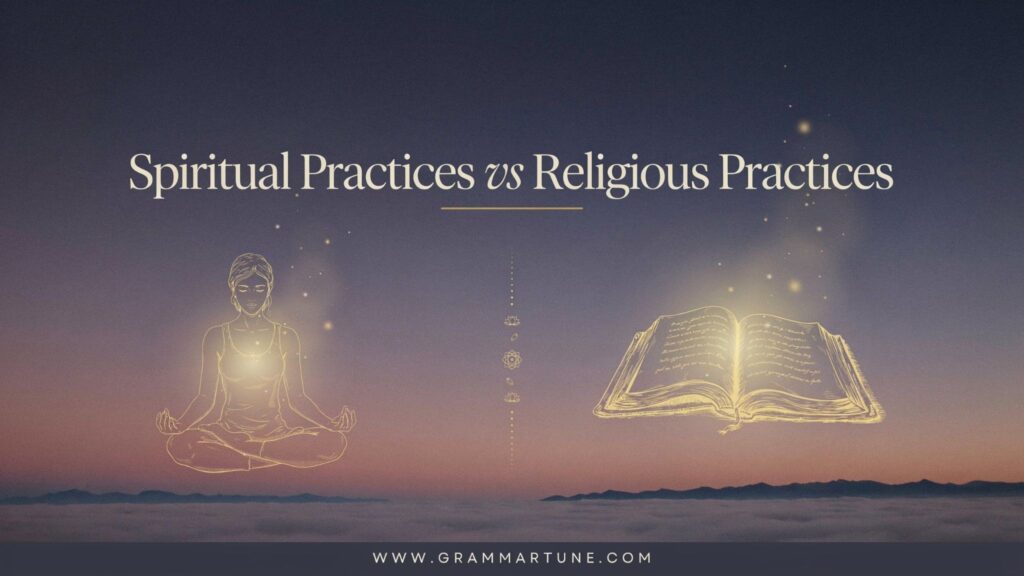
Another useful way to understand the difference is to compare spiritual practices with religious practices.
Spiritual practices can be highly individual. Someone may choose meditation because it helps them become more aware of their thoughts and emotions.
Religious practices are usually connected with the teachings and traditions of a particular faith. For example, prayer can belong to both categories.
Someone may pray as part of an established religious tradition. Another person may use personal prayer as a private form of reflection without belonging to a specific religion.
The activity may look similar, but its meaning can be very different.
Meditation and Mindfulness
Meditation is practiced in many religious and spiritual contexts.
Some traditions use meditation as part of a larger path toward insight, devotion, liberation, or awareness. In modern settings, people may also practice meditation for mindfulness, stress management, or personal reflection.
Mindfulness focuses on paying attention to the present moment without immediately judging the experience.
Both practices can appear in religious settings and secular spiritual lifestyles.
Prayer and Reflection
Prayer is more strongly associated with religion, although personal spiritual practices can also include prayer.
For religious believers, prayer may involve worship, gratitude, confession, asking for guidance, or communicating with the divine.
For others, quiet reflection may serve a similar emotional or contemplative purpose without being connected to formal religious belief.
Spirituality and Religion Both Search for Meaning
Despite their differences, spirituality and religion share an important feature: both can help people explore the meaning of life.
People often ask difficult questions during periods of change.
Why did this happen?
What should I do next?
What makes life meaningful?
How should I deal with suffering?
What kind of person do I want to become?
Religion may answer these questions through established teachings and traditions. Spirituality may encourage an individual to explore them through personal experience and reflection.
Sometimes, both approaches work together.
Spirituality, Religion, and Inner Peace
People often turn toward spiritual or religious practices when they want greater inner peace. A regular practice can create time for reflection in an otherwise busy life.
Prayer may provide comfort and hope. Meditation may create a sense of stillness. Religious communities may reduce feelings of isolation. Gratitude may shift attention toward positive aspects of life.
However, neither spirituality nor religion guarantees constant happiness. Life still includes uncertainty, grief, conflict, disappointment, and stress.
A spiritual or religious framework may instead help a person interpret these experiences and respond to them differently.
Spirituality and Mental Health
The connection between spirituality and mental health is complicated and shouldn’t be reduced to a simple claim that spirituality always improves wellbeing.
For some people, spiritual or religious beliefs can provide hope, community, purpose, and emotional support. Religious communities can also offer social connections during difficult periods.
Mindfulness and meditation may help some people become more aware of their thoughts and emotions.
At the same time, spiritual beliefs can sometimes become a source of distress if they create intense fear, guilt, isolation, or conflict.
That’s why context matters.
Spirituality shouldn’t replace professional mental health care when someone is dealing with serious psychological difficulties. A person can maintain spiritual beliefs while also seeking appropriate professional support.
Spiritual Experience vs Religious Experience
A spiritual experience is usually understood as a deeply meaningful experience that creates a strong sense of connection, awareness, transcendence, peace, or insight.
A religious experience may involve similar feelings but is interpreted through a particular religious tradition.
For example, one person might describe an overwhelming sense of unity while meditating in nature as a spiritual experience.
Another person might describe a profound sense of God’s presence during prayer as a religious experience.
Both experiences can be deeply meaningful to the people who have them.
Their interpretation often depends on culture, belief, personal history, and religious background.
Are Spiritual and Religious Experiences the Same?
Not always.
There can be significant overlap, but the interpretation differs. A religious experience is often connected to a specific faith tradition, while a spiritual experience can occur outside organized religion.
For example, someone without a religious affiliation may still describe a powerful experience of connection while watching the ocean, listening to music, or spending time in nature.
Spirituality Across Different Religious Traditions
Spirituality isn’t limited to one culture or belief system. Christian spirituality can involve prayer, faith, love, forgiveness, service, and a relationship with God.
In Hindu traditions, spiritual paths may include devotion, meditation, self-inquiry, and different forms of yoga. Jñāna yoga, for example, emphasizes knowledge and understanding.
Sikh spirituality includes devotion, remembrance of God, service, equality, and honest living.
Buddhist traditions often emphasize mindfulness, meditation, compassion, ethical living, and insight.
These traditions shouldn’t be treated as identical. Each developed within a distinct historical and cultural context.
Modern discussions of spirituality have also been influenced by ideas associated with transcendentalism, neo-Vedanta, Hindu universalism, psychology, and contemporary spirituality.
Why Do People Choose Religion?
People may choose or maintain a religious tradition for many reasons.
Religion can provide:
- A sense of belonging
- Shared beliefs
- Moral guidance
- Community support
- Religious identity
- Ritual and tradition
- A framework for understanding life
- A relationship with the divine
- Hope during difficult experiences
For some people, religion is deeply connected with family and culture. For others, it results from a personal religious experience or a deliberate search for faith. There is no single reason why people become religious.
Why Do People Explore Spirituality?
People may explore spirituality for equally varied reasons. Some want to understand themselves better. Others are searching for personal growth, inner peace, purpose, or meaning.
A major life event can also trigger spiritual reflection.
Someone who experiences loss may begin asking deeper questions about life. A person who feels disconnected from their daily routine may begin exploring meditation or mindfulness.
For some, spiritual exploration happens gradually rather than through one dramatic experience.
Does Spirituality Conflict With Religion?
It doesn’t have to. The idea that spirituality and religion are always opposites is too simplistic.
Many people have a strong religious identity and also describe themselves as deeply spiritual. Their religion provides the tradition, while spirituality describes their personal relationship with that tradition.
For example, attending a religious service may be a religious practice, while the personal sense of connection, reflection, faith, or devotion experienced during that service may be described as spiritual.
The two can therefore complement each other.
Spirituality vs Religion in Modern Life
Modern life has changed how many people approach spirituality and religion. People now have access to ideas from different cultures, philosophies, religious traditions, and psychological approaches.
Someone might study Buddhist mindfulness, read Christian spiritual writings, learn about Hindu philosophy, and explore modern psychology without formally joining any of these traditions.
This doesn’t necessarily mean that traditional religion is disappearing. Instead, it shows that people increasingly encounter a wide range of ideas about meaning, purpose, consciousness, wellbeing, and personal growth.
The modern spiritual landscape can therefore be both diverse and complex.
How to Explore Spirituality Without Losing Balance
If you’re interested in spirituality, you don’t need to accept every idea you encounter. A thoughtful approach can help. Start by asking what you’re actually looking for.
Do you want inner peace? A stronger sense of purpose? A deeper religious faith? Better self-awareness? A way to reflect on difficult experiences?
Once you understand your goal, explore practices that fit it. You can begin with simple activities such as meditation, journaling, prayer, reading, mindful walking, gratitude, or spending quiet time in nature.
Most importantly, stay curious.
A spiritual journey doesn’t require abandoning critical thinking. You can explore meaningful ideas while still asking questions and examining your assumptions.
Final Thoughts
The difference between spirituality vs religion isn’t simply that one is personal and the other is organized. The relationship is more nuanced.
Religion generally provides a shared system of beliefs, traditions, practices, and community. Spirituality often emphasizes personal experience, meaning, awareness, connection, and the search for a deeper understanding of life.
For some people, spirituality exists within religion. For others, it exists outside formal religious structures. Neither path has to look exactly the same for everyone.
What matters is understanding what these concepts mean to you and how they influence your values, relationships, decisions, and sense of purpose.
Whether your path involves prayer, meditation, religious community, mindfulness, service, or personal reflection, the search for meaning remains one of the most deeply human parts of life.

Will Smith is a passionate spiritual writer and explorer, sharing insights on soul growth, inner healing, and the deeper meanings behind dreams, symbols, and emotions. As the voice behind Spirit Skyway, he helps readers connect with higher wisdom through affirmations, spiritual tools, and ancient truths. Will believes that spirituality is not just a practice but a way of life — and invites you to journey inward through the divine skyway of the soul.